NFT Storefront Smart Contract
The NFT Storefront contracts implement a standard way to list NFTs for sale and buy them from listings. NFTStorefrontV2 is the more powerful and full-featured version, so developers and users are encouraged to use it instead of NFTStorefront or their own implementation.
Source: NFTStorefrontV2.cdc
| Network | Contract Address |
|---|---|
| Emulator | 0xf8d6e0586b0a20c7 |
| Cadence Testing Framework | 0x0000000000000001 |
| Testnet | 0x2d55b98eb200daef |
| Mainnet | 0x4eb8a10cb9f87357 |
Source: NFTStorefront.cdc
| Network | Contract Address |
|---|---|
| Testnet | 0x94b06cfca1d8a476 |
| Mainnet | 0x4eb8a10cb9f87357 |
Primer
The NFTStorefrontV2 contract lets you create a non-custodial Resource (NFT) marketplace on the FLOW blockchain.
NFTStorefrontV2 makes it simple for Sellers to list NFTs in dApp specific marketplaces. dApp developers leverage the APIs provided by the contract to manage listings for sale and to transact NFT trades.

Developers should use the NFTStorefrontV2 to create their marketplace and to alloq p2p purchases. The diagram below shows how dApps can facilitate the creation of NFT listings for different marketplaces and how marketplaces can filter their listings.
Listings made through a specific dApp storefront can be simultaneously listed on 3rd party marketplaces beyond that dApp. Well known 3rd party marketplaces listen for compatible NFT listing events, which allows the automation of listings into their marketplace dashboards.

With the NFTStorefrontV2, marketplaces can instantly and easily tap into the vibrant FLOW NFT ecosystem and allow NFT holders to list their NFTs and allows creator royalties.
Marketplaces then interact with seller storefronts directly to process an NFT trade. Flow's account based model ensures that NFTs listed for sale always reside in the Seller account until traded, regardless of how many Listings are posted across any number of marketplaces, for the same NFT.

Functional overview
A general purpose sale support contract for NFTs that implement the Flow NonFungibleToken standard. Each account that wants to list NFTs for sale creates a Storefront resource to store in their account and lists individual sales within that Storefront as listings. There is usually one Storefront per account held at the /storage/NFTStorefrontV2.
Each listing can define one or more sale cuts taken out of the sale price to go to one or more addresses. Listing fees, royalties, or other considerations can be paid with sale cuts. Also, the listing can include a commission as one of these sale cuts is paid to whoever facilitates the purchase.
Listings can have an optional list of marketplace receiver capabilities used to receive the commission after the seller fulfills the listing. An NFT may be listed in one or more listings, and the validity of each listing can easily be checked.
Interested parties can globally track listing events onchain and filter by NFT types, IDs and other characteristics to determine which to make available for purchase within their own marketplace UIs."
Sell NFTs
NFTStorefrontV2 offers a generic process for creating the listing for an NFT. It provides all the essential APIs to manage those listings independently.
Many marketplaces create a single storefront resource to manage different individual listings. We recommend that you create the listing under the user-owned storefront resource to make it trustless and platform-independent. Users should possess the Storefront resource under their account to create the listing using the storefront contract.
Create a successful listing with the NFTStorefrontV2 contract.
As recommended above, the first step is to create and store the Storefront resource in the user account with the setup_account transaction.
The next step is to create a listing under the newly-created storefront resource. If the user (repetitive) already holds the storefront resource, then use the current resource. The seller can come with multiple requirements to list their NFTs, and we try our best to cover most of them below.
Scenario 1: Sell NFTs that correspond to more than one cryptocurrency, such as FLOW, USDC etc.
The NFTStorefrontV2 contract doesn't support an NFT sale for multiple different currencies with a single listing. However, to achieve this, you can create multiple listings for the same NFT for each different currency.
Example - Alice wants to sell a kitty and is open to receive FLOW and USDC
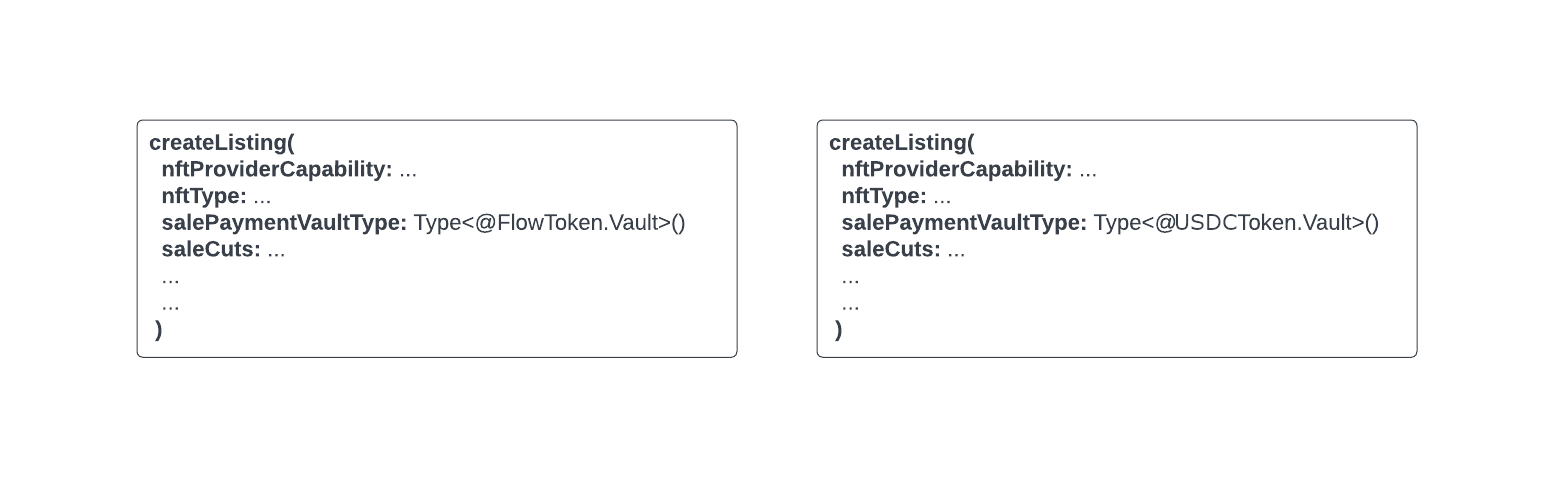
A seller puts an NFT on sale, a process called listing. To create a listing with the sell_item transaction, the seller provides some required details to list an NFT, such as the receiving currency type, and the Capability from where the network deducts the NFT. For more information, see createListing.
To receive a different currency, the seller must provide a different Receiver currency type , such as salePaymentVaultType. As depicted in the above diagram, there are two listing formations with almost the same inputs. The only differentiator is the salePaymentVaultType parameter that needs to be different when the seller creates duplicate NFT listings with different sale currency types.
Scenario 2: Peer-to-Peer (p2p) listing of NFT: A listing anyone can fulfill.
dApps can leverage the NFTStorefrontV2 to facilitate a listing's creation for the seller independent of any marketplace. dApps or marketplaces can list those listings on their platforms, or seller can settle it p2p.
The seller can use sell_item transaction to create a p2p listing. To do this, they provide the marketplacesAddress with an empty array. The seller can provide commission to the facilitator of sale, which can also act as a discount if the facilitator and the purchaser are the same.
Scenario 3: The seller wants to list its NFT in different marketplaces.
NFTStorefrontV2 offers two different ways to do it.
-
The seller can create a listing and provide the
marketplacesAddressthat it wants to have a listing on with the sell_item transaction.Marketplaces can listen to
ListingAvailableevents and check whether their address is included in thecommissionReceiverslist; If yes, the marketplace would be rewarded during the successful fulfilment of the listing.Example - Bob wants to list on marketplace 0xA, 0xB & 0xC and will offer 10% commission on the sale price of the listing to the marketplaces.

-
Another way to accomplish this is to create separate listings for each marketplace on which a user wants their listing with the sell_item_with_marketplace_cut transaction. In this case, the marketplace would earn one part of the
saleCutas an incentive. It appends the marketplace saleCut in thesaleCutsarray when it creates the listing.
Considerations
- Ghost listings - Ghost listings are listings which don't have an underlying NFT in the seller's account. However, the listing is still available for buyers to attempt to purchase. StorefrontV2 is not immune to ghost listings. Usually, ghost listings will cause a purchaser's transaction to fail, which is annoying but isn't a significant problem. Ghost listings become a problem for the seller when the listed NFT comes back to the seller's account after its original sale. The ghost listing will no longer be invalid when it comes back, and anyone can purchase it even if the seller doesn't want to sell it at that price anymore.
We recommend that marketplaces and p2p dApps create an off-chain notification service that tells their users (sellers) to remove the listings if they don't hold the NFT anymore in the same account.
- Expired listings -
NFTStorefrontV2introduces a safety measure to specify that a listing will expire after a certain period that can be set during the creation so no one can purchase the listing anymore. It is not a fool-proof safety measure, but it does give some safe ground to the sellers for the ghost listings & stale listings.
We recommended for marketplaces and p2p dApps not to show the expired listings on their dashboards.
Purchase NFTs
To purchase NFTs through the NFTStorefrontV2 is simple. The buyer has to provide the payment vault and the commissionRecipient , if applicable, during the purchase. p2p dApps don't need any intermediaries to facilitate the purchase of listings. purchase API offered by the Listing resource gets used to facilitate the purchase of NFT.
During the listing purchase, all saleCuts are paid automatically. This also includes royalty distribution for that NFT, if applicable. If the vault provided by the buyer lacks sufficient funds, then the transaction will fail.
Considerations
- Auto cleanup -
NFTStorefrontV2offers a unique ability to do auto cleanup of duplicate listings during a purchase. It comes with a drawback if one NFT has thousands of duplicate listings. It will become the bottleneck during purchases one of the listings as it will likely trigger an out-of-compute error.
We recommended NOT to have more than 50 duplicate listings of any given NFT.
- Unsupported receiver capability - A common pitfall during the purchase of an NFT that some saleCut receivers don't have a supported receiver capability because that entitled sale cut would transfer to first valid sale cut receiver. However, it can be partially solved if you provide the generic receiver with the
FungibleTokenSwitchboardcontract and add all the currency capabilities the beneficiary wants to receive. For more information about theFungibleTokenSwitchboard, see Fungible Token Switchboard
Allow creator royalties for NFTs
The NFTStorefrontV2 contract optionally supports royalty payments to the minter account for secondary resales of that NFT after the original sale. Marketplaces decide for themselves whether to support creator royalties when they validate listings for sale eligibility. We encourage all marketplaces to support creator royalties and support community creators in the FLOW ecosystem.
If a seller's NFT supports the Royalty Metadata View standard, then marketplaces can honor royalties payments at time of purchase. NFTStorefrontV2 dynamically calculates the royalties owed at the time of listing creation and applies it as a saleCut of the listing at the time of purchase.
_16// Check whether the NFT implements the MetadataResolver or not._16if nft.getViews().contains(Type<MetadataViews.Royalties>()) {_16 // Resolve the royalty view_16 let royaltiesRef = nft.resolveView(Type<MetadataViews.Royalties>())_16 ?? panic("Unable to retrieve the royalties view for the NFT with type "_16 .concat(nft.getType().identifier).concat(" and ID ")_16 .concat(nft.id.toString()).concat(".")_16 // Fetch the royalties._16 let royalties = (royaltiesRef as! MetadataViews.Royalties).getRoyalties()_16_16 // Append the royalties as the salecut_16 for royalty in royalties {_16 self.saleCuts.append(NFTStorefrontV2.SaleCut(receiver: royalty.receiver, amount: royalty.cut * effectiveSaleItemPrice))_16 totalRoyaltyCut = totalRoyaltyCut + royalty.cut * effectiveSaleItemPrice_16 }_16}
You can view a complete transaction in sell_item.
saleCut only supports a single token receiver type and therefore beneficiaries of a saleCut can also only receive the token type used for the purchase. To support different token types for saleCuts, we recommend that you use the FungibleTokenSwitchboard contract. The contract defines a generic receiver for fungible tokens which itself handles routing of tokens to the respective vault for that token type. You can learn more about this in Fungible Token Switchboard.
Allow marketplace commissions for NFT sales
NFTStorefrontV2 allows optional commissions on trades for marketplaces which require it as a condition to list a NFT for sale. The seller sets commission and commission receivers during initial listing creation. At time of purchase, the commission amount is paid once only to the commission receiver that matches the marketplace receiver address which facilitated the sale.
For NFT listings in marketplaces which don't require commission, you can set commission receivers as nil. If you set the buyer of the NFT and commissionRecipient to nil, it applies a discount for the buyer.
 .
.
APIs and events offered by NFTStorefrontV2
Resource Interface ListingPublic
_10resource interface ListingPublic {_10 access(all) fun borrowNFT(): &NonFungibleToken.NFT?_10 access(all) fun purchase(_10 payment: @FungibleToken.Vault,_10 commissionRecipient: Capability<&{FungibleToken.Receiver}>?,_10 ): @NonFungibleToken.NFT_10 access(all) fun getDetails(): ListingDetail_10 access(all) fun getAllowedCommissionReceivers(): [Capability<&{FungibleToken.Receiver}>]?_10}
An interface that provides a useful public interface to a Listing.
Functions
fun borrowNFT()
_10fun borrowNFT(): &NonFungibleToken.NFT?
This will assert in the same way as the NFT standard borrowNFT() if the NFT is absent, for example if it has been sold via another listing.
fun purchase()
_10fun purchase(payment FungibleToken.Vault, commissionRecipient Capability<&{FungibleToken.Receiver}>?): NonFungibleToken.NFT
Facilitates the purchase of the listing by providing the payment vault and the commission recipient capability if there is a non-zero commission for the given listing. Respective saleCuts are transferred to beneficiaries and funtion return underlying or listed NFT.
fun getDetails()
_10fun getDetails(): ListingDetails
Fetches the details of the listings.
fun getAllowedCommissionReceivers()
_10fun getAllowedCommissionReceivers(): [Capability<&{FungibleToken.Receiver}>]?
Fetches the allowed marketplaces capabilities or commission receivers for the underlying listing. If it returns nil, then commission is up for grabs by anyone.
Resource Storefront
_18resource Storefront {_18 access(all) fun createListing(_18 nftProviderCapability: Capability<&{NonFungibleToken.Provider, NonFungibleToken.CollectionPublic}>,_18 nftType: Type,_18 nftID: UInt64,_18 salePaymentVaultType: Type,_18 saleCuts: [SaleCut],_18 marketplacesCapability: [Capability<&{FungibleToken.Receiver}>]?,_18 customID: String?,_18 commissionAmount: UFix64,_18 expiry: UInt64_18 ): UInt64_18 access(all) fun removeListing(listingResourceID: UInt64)_18 access(all) fun getListingIDs(): [UInt64]_18 access(all) fun getDuplicateListingIDs(nftType: Type, nftID: UInt64, listingID: UInt64): [UInt64]_18 access(all) fun cleanupExpiredListings(fromIndex: UInt64, toIndex: UInt64)_18 access(all) fun borrowListing(listingResourceID: UInt64): &Listing{ListingPublic}?_18}
A resource that allows its owner to manage a set of listings, and anyone to interact with them in order to query their details and purchase the NFTs that they represent.
Implemented Interfaces:
StorefrontManagerStorefrontPublic
Initializer
_10fun init()
Functions
fun createListing()
_10fun createListing(nftProviderCapability Capability<&{NonFungibleToken.Provider, NonFungibleToken.CollectionPublic}>, nftType Type, nftID UInt64, salePaymentVaultType Type, saleCuts [SaleCut], marketplacesCapability [Capability<&{FungibleToken.Receiver}>]?, customID String?, commissionAmount UFix64, expiry UInt64): UInt64
insert Create and publish a listing for an NFT.
fun removeListing()
_10fun removeListing(listingResourceID UInt64)
removeListing Remove a listing that has not yet been purchased from the collection and destroy it.
fun getListingIDs()
_10fun getListingIDs(): [UInt64]
getListingIDs Returns an array of the listing resource IDs that are in the collection.
fun getDuplicateListingIDs()
_10fun getDuplicateListingIDs(nftType Type, nftID UInt64, listingID UInt64): [UInt64]
getDuplicateListingIDs
Returns an array of listing IDs that are duplicates of the given nftType and nftID.
fun cleanupExpiredListings()
_10fun cleanupExpiredListings(fromIndex UInt64, toIndex UInt64)
cleanupExpiredListings Iterate over the provided range of indexes to clean up the expired listings.
fun borrowListing()
_10fun borrowListing(listingResourceID: UInt64): &{ListingPublic}?
borrowListing Returns a read-only view of the listing for the given listingID if it is contained by this collection.
Resource Interface StorefrontPublic
_10resource interface StorefrontPublic {_10 access(all) fun getListingIDs(): [UInt64]_10 access(all) fun getDuplicateListingIDs(nftType: Type, nftID: UInt64, listingID: UInt64): [UInt64]_10 access(all) fun cleanupExpiredListings(fromIndex: UInt64, toIndex: UInt64)_10 access(all) fun borrowListing(listingResourceID: UInt64): &Listing{ListingPublic}?_10 access(all) fun cleanupPurchasedListings(listingResourceID: UInt64)_10 access(all) fun getExistingListingIDs(nftType: Type, nftID: UInt64): [UInt64]_10}
StorefrontPublic An interface to allow listing and borrowing listings, and purchase items via listings in a Storefront.
Functions
fun getListingIDs()
_10fun getListingIDs(): [UInt64]
getListingIDs Returns an array of the listing resource IDs that are in the collection
fun getDuplicateListingIDs()
_10fun getDuplicateListingIDs(nftType Type, nftID UInt64, listingID UInt64): [UInt64]
getDuplicateListingIDs Returns an array of listing IDs that are duplicates of the given nftType and nftID.
fun borrowListing()
_10fun borrowListing(listingResourceID UInt64): &Listing{ListingPublic}?
borrowListing Returns a read-only view of the listing for the given listingID if it is contained by this collection.
fun cleanupExpiredListings()
_10fun cleanupExpiredListings(fromIndex UInt64, toIndex UInt64)
cleanupExpiredListings Iterates over the provided range of indexes to clean up the expired listing.
fun cleanupPurchasedListings()
_10fun cleanupPurchasedListings(listingResourceID: UInt64)
cleanupPurchasedListings Allows anyone to remove already purchased listings.
fun getExistingListingIDs()
_10fun getExistingListingIDs(nftType Type, nftID UInt64): [UInt64]
getExistingListingIDs
Returns an array of listing IDs of the given nftType and nftID.
Events
event StorefrontInitialized
_10event StorefrontInitialized(storefrontResourceID: UInt64)
A Storefront resource was created. Consumers can now expect events from this Storefront. We do not specify an address: we cannot and should not. Created resources do not have an owner address, and may be moved after creation in ways we cannot check. ListingAvailable events can be used to determine the address of the owner of the Storefront at the time of the listing but only at that precise moment in that precise transaction. If the seller moves the Storefront while the listing is valid, that is on them.
event StorefrontDestroyed
_10event StorefrontDestroyed(storefrontResourceID: UInt64)
A Storefront has been destroyed. Event consumers can now stop processing events from this Storefront. We do not specify an address.
event ListingAvailable
_10event ListingAvailable(storefrontAddress: Address, listingResourceID: UInt64, nftType: Type, nftUUID: UInt64, nftID: UInt64, salePaymentVaultType: Type, salePrice: UFix64, customID: String?, commissionAmount: UFix64, commissionReceivers: [Address]?, expiry: UInt64)
Above event gets emitted when a listing is created and added to a Storefront resource. The Address values here are valid when the event is emitted, but the state of the accounts they refer to may change outside of the NFTStorefrontV2 workflow, so be careful to check when you use them.
event ListingCompleted
_10event ListingCompleted(listingResourceID: UInt64, storefrontResourceID: UInt64, purchased: Bool, nftType: Type, nftUUID: UInt64, nftID: UInt64, salePaymentVaultType: Type, salePrice: UFix64, customID: String?, commissionAmount: UFix64, commissionReceiver: Address?, expiry: UInt64)
The listing was resolved. It was either purchased, removed or destroyed.
event UnpaidReceiver
_10event UnpaidReceiver(receiver: Address, entitledSaleCut: UFix64)
A entitled receiver wasn't paid during the sale of the NFT.
Holistic process flow diagram of NFTStorefrontV2 -
